How To Raise A Reader
As we celebrate Read Across America Week, it’s the perfect time to reflect on how we can raise confident, engaged readers from the very beginning. Early literacy is about more than books — it’s about connection, communication, and shared experiences.
The Baby Signs® Program enhances language development and supports early literacy by giving babies and toddlers a way to actively participate during story time. When we incorporate simple signs into our reading routines, children can express themselves, engage more deeply with stories, and build the confidence that fuels a lifelong love of learning.
Let’s sign, read, and celebrate the joy of literacy — not just this week, but all year long.
As Dr. Linda Acredolo, co-creator of the Baby Signs® Program and coauthor of Baby Minds, explains, reading with your child is one of the most meaningful bonding experiences you can share.
When you settle into a cozy chair and open a book together, your child receives your undivided attention — and that connection makes story time truly magical. Daily reading doesn’t just build warm memories; it strengthens language development, expands vocabulary, fuels imagination, and prepares children for school success.
Even more importantly, reading together teaches children that books are safe, joyful spaces — and that association is what helps create lifelong readers.
Reading with Babies
You can’t start the reading habit too early. Even in the first months of life, babies are absorbing language, rhythm, and connection. Between 3 and 6 months, your baby may be more interested in chewing a board book than listening to the story — and that’s completely normal. Books at this stage are sensory experiences.
By the end of the first year, many babies begin to show clear preferences. They may reach for favorite books, anticipate page turns, or smile at familiar pictures.
What Babies Learn During Story Time
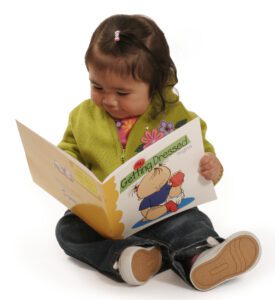
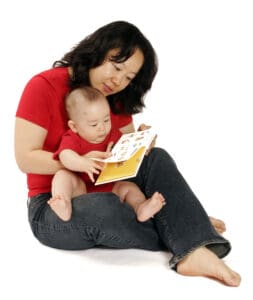
When you hold your baby and turn the pages together, she begins to associate books with comfort and closeness. That emotional connection is powerful. Babies quickly learn that books mean snuggles, attention, and shared joy.
Reading aloud also strengthens language development. Babies start connecting pictures with words and become increasingly tuned in to tone of voice, cadence, and sentence patterns. Around 9 months, many infants show growing awareness of familiar words and rhythms.
Parents and caregivers support early language growth by speaking often, using varied vocabulary, and talking about topics that interest their child. Daily reading builds these foundational language skills in a natural, enjoyable way.
Make Reading Fun and Interactive
Choose books that invite exploration.
Sturdy board books and cloth books allow babies to safely explore with their hands and mouths.
Focus on faces.
Infants are naturally drawn to pictures of faces, especially other babies.
Be expressive and playful.
Add sound effects. Change your voice. Pause for dramatic effect. Let story time feel lively and engaging.
Connect books to the real world.
If you read about a dog, point out a dog during your walk. If you read about a ball, find one to roll. These real-life connections strengthen vocabulary and comprehension.
Add simple signs during reading.
Use signs like book, more, dog, eat, or all done to help your baby participate. Signing turns reading into a two-way experience and reinforces the words they hear.
The Power of Baby Signs® in Early Literacy
The Baby Signs® Program is about more than teaching simple gestures — it empowers infants and toddlers to communicate their needs, thoughts, and feelings long before they can speak. By introducing signs for everyday words like more, eat, book, and dog, parents and caregivers give children a voice during the earliest stages of language development.
When children can express themselves, frustration decreases and confidence grows. That confidence carries directly into literacy development.
Research on the Baby Signs® Program has shown that children who use signs often develop larger spoken vocabularies and strong language skills. Early signing supports the connection between symbols and meaning — a foundational skill for reading. As children link a hand sign to a spoken word and then to a printed word in a book, they are building neural pathways that support comprehension and communication.
Signing also transforms story time into an interactive experience. When parents incorporate relevant signs into reading, children can actively participate rather than simply listen. This multisensory engagement deepens understanding, strengthens memory, and makes books more meaningful.
When reading becomes interactive, joyful, and empowering, children are more likely to develop a lifelong love of literacy.
 Learn more about how signing supports literacy development here:
https://babysigns.com/linking-the-baby-signs-program-and-literacy-development/
Ready to take the next step in supporting early communication and literacy?
Visit BabySigns.com to learn more about the Baby Signs® Instructor Program and discover how you can bring the power of early signing to families in your community.
Have questions? We’d love to hear from you. Email us at info@babysigns.com
