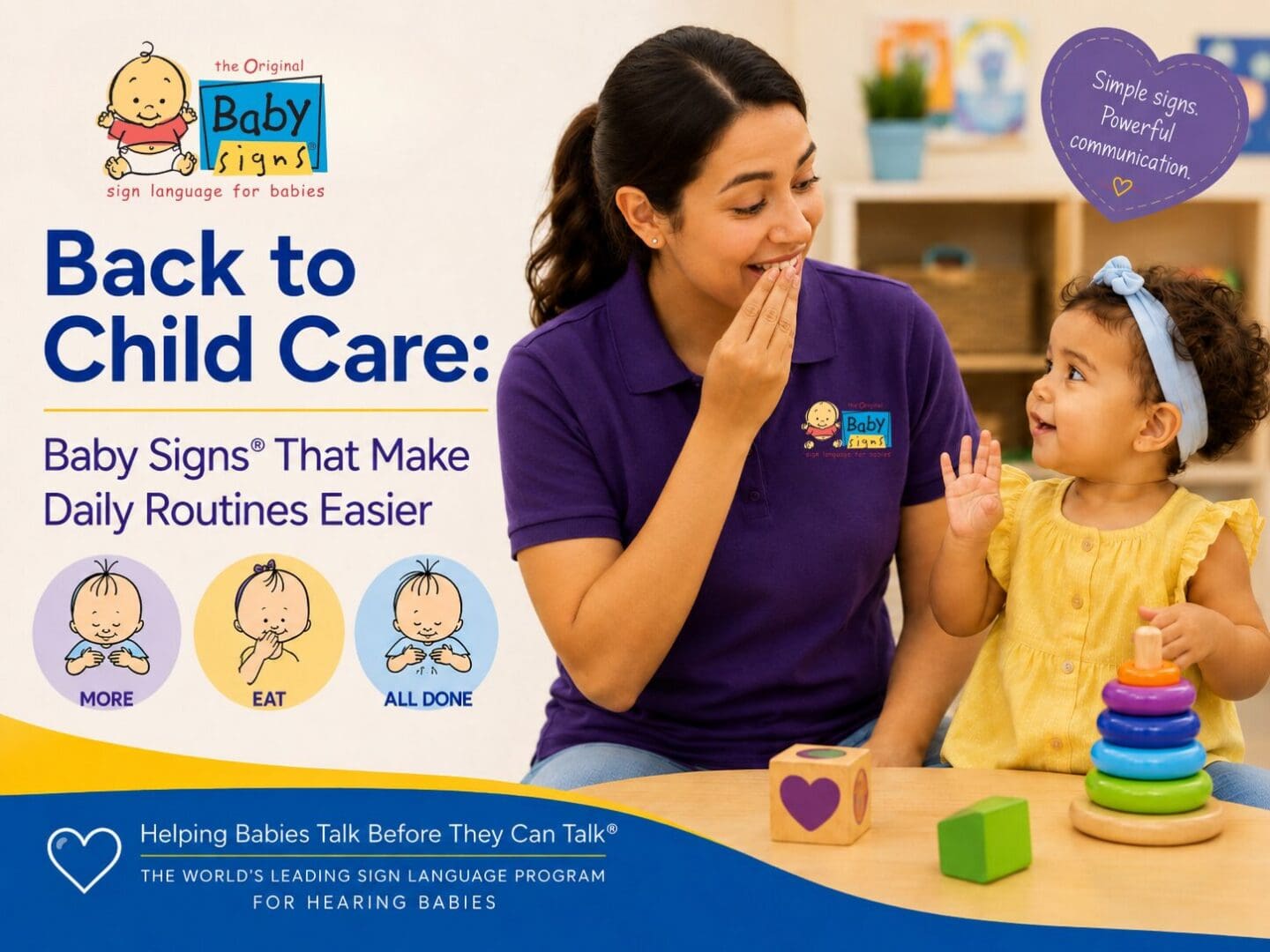
Back to Child Care: Baby Signs® That Make Daily Routines Easier
As summer winds down and families settle back into more regular routines, many babies and toddlers are spending more time with child care providers, grandparents, family members, or other caregivers.
For little ones who are still learning to talk, these transitions can sometimes be challenging. Babies may know exactly what they want, need, or feel, but they do not yet have the words to tell us.
That is where the Baby Signs® Program can help.
Using simple signs during familiar daily routines gives babies and toddlers a way to communicate before they can say all the words they understand. And when parents and caregivers use the same signs consistently, those signs can become a helpful bridge between home and child care.
Why Baby Signs® Work So Well During Daily Routines
Babies learn through repetition, and child care days are full of repeated experiences: eating, diaper changes, naps, playtime, going outside, cleaning up, and saying goodbye.
These everyday moments provide natural opportunities to use signs.
There is no need to stop what you are doing for a formal "sign lesson." Instead, adults simply say the word and show the sign as part of the conversation.
For example:
"It's time to EAT."
"Would you like MORE?"
"Are you ALL DONE?"
"Do you need HELP?"
"We need to WAIT."
Over time, babies begin to understand that the sign has meaning. When they are developmentally ready, they may begin using the sign themselves.
This approach has even been studied in child care settings(opens in new tab). Research(opens in new tab) examining the use of Baby Signs® with infants and caregivers at the University of California, Davis Center for Child and Family Studies found that signs provided children with another way to participate in their care. Researchers also found that caregivers were more sensitive and responsive during interactions in which they used more gestures.
In other words, signing is not just about teaching babies signs. It can also encourage adults to slow down, watch more closely, and notice what babies are trying to communicate.
Signs for Drop-Off and Separation
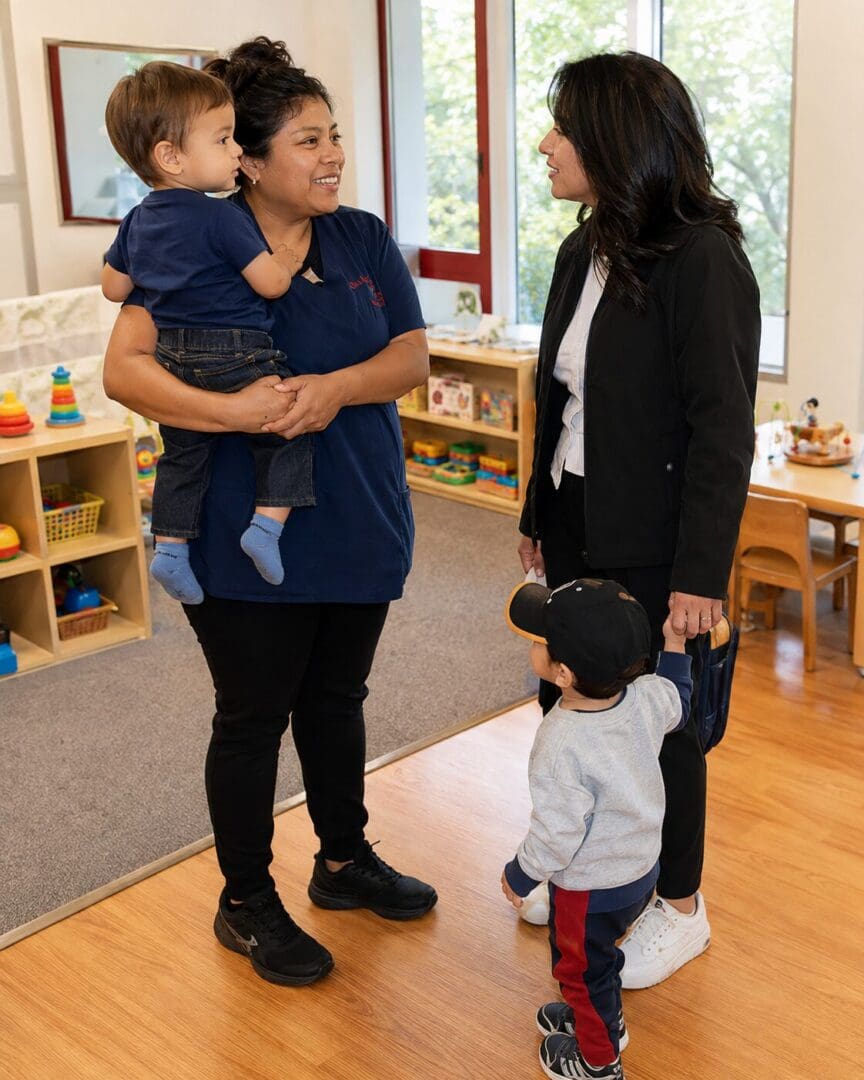
Saying goodbye can be one of the most emotional parts of the child care day, especially when a baby or toddler is adjusting to a new caregiver or routine.
Signs can give children another way to express what is on their minds.
Useful signs might include:
- MOMMY
- DADDY
- SAD
- PLAY
- ALL DONE
If a toddler signs MOMMY after a parent leaves, the caregiver now has valuable information.
Instead of simply seeing a child who is upset, the caregiver can acknowledge the message:
"You're thinking about Mommy. Mommy will come back. Right now we're going to PLAY."
Being understood does not necessarily make the feeling disappear, but it lets the child know that their message was received.
Signs for Meals and Snacks
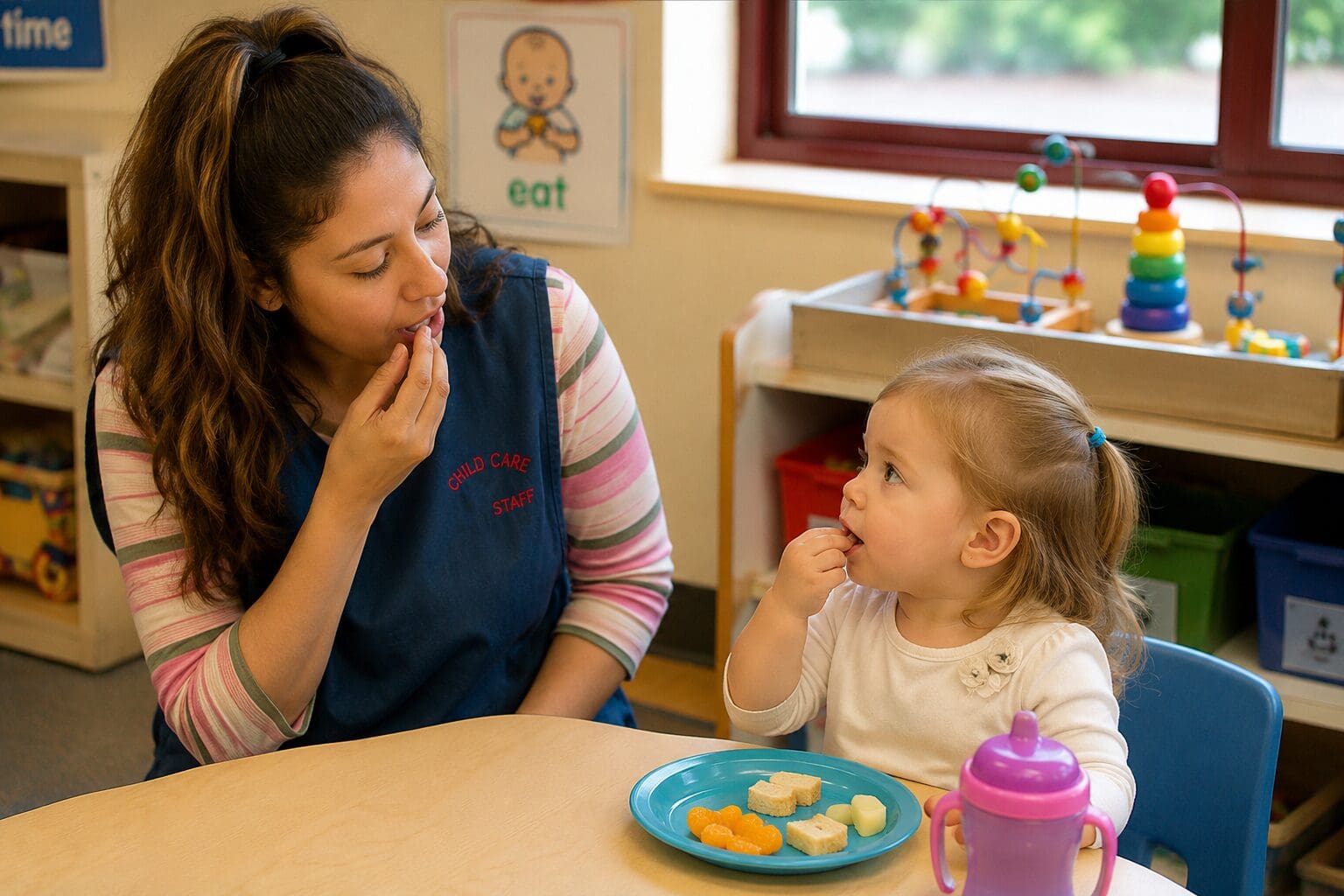
Mealtimes are one of the easiest places to begin signing because babies are highly motivated to communicate about food.
A few useful mealtime signs include:
- EAT
- DRINK
- MORE
- ALL DONE
- MILK
Imagine how helpful it can be when a preverbal toddler can tell a caregiver that they want MORE instead of crying or reaching, or can clearly indicate ALL DONE instead of pushing food away.
These little moments of communication can make routines easier for both children and caregivers.
Signs for Diapering and Personal Care
Diaper changes happen several times a day, making them another wonderful opportunity for repetition.
Caregivers might use signs such as:
- DIAPER
- HURT
- HELP
- ALL DONE
- WASH
Before beginning, a caregiver can sign and say, "It's time to change your DIAPER."
During the routine, the caregiver can continue talking and signing about what is happening.
This helps turn a caregiving task into a communication opportunity and allows the baby to participate more actively in what is happening to their body.
The sign HURT can be especially valuable. A baby or toddler who can communicate that something hurts has an important additional tool for getting an adult's attention.
Signs for Play and Social Situations
As babies become toddlers, interactions with other children become a bigger part of the day. But social situations can be tricky when children have lots to communicate and very few spoken words available.
When toddlers are still developing spoken language, having another way to communicate(opens in new tab) can help them express needs, feelings, and boundaries during social interactions.
Helpful signs for playtime can include:
- PLAY
- HELP
- STOP
- GENTLE
- HURT
- WAIT
A toddler who needs assistance can sign HELP.
A child who is uncomfortable with another child's behavior can learn to use STOP.
An adult can pair the sign GENTLE with the spoken word while helping children learn how to interact appropriately with friends.
Signs do not replace adult guidance, of course. They simply give young children another communication tool they can use while their spoken language is still developing.
Signs Can Make Transitions More Predictable
Transitions are often some of the most challenging moments in an infant or toddler classroom.
It is time to stop playing.
Someone else is using the toy.
Lunch is over.
We need to wait before going outside.
Dad has not arrived yet.
For a young child with limited spoken language, these moments can be frustrating.
Signs such as WAIT, ALL DONE, HELP, PLAY, EAT, and SLEEP can help caregivers communicate what is happening and give children ways to respond.
One of the most powerful things about signing is that it makes communication a two-way experience. Adults are not simply telling children what will happen next. They are also giving children a way to participate in the conversation.
Home + Child Care: Consistency Makes It Easier
Babies do not need every adult in their lives to know dozens of signs.
Start small.
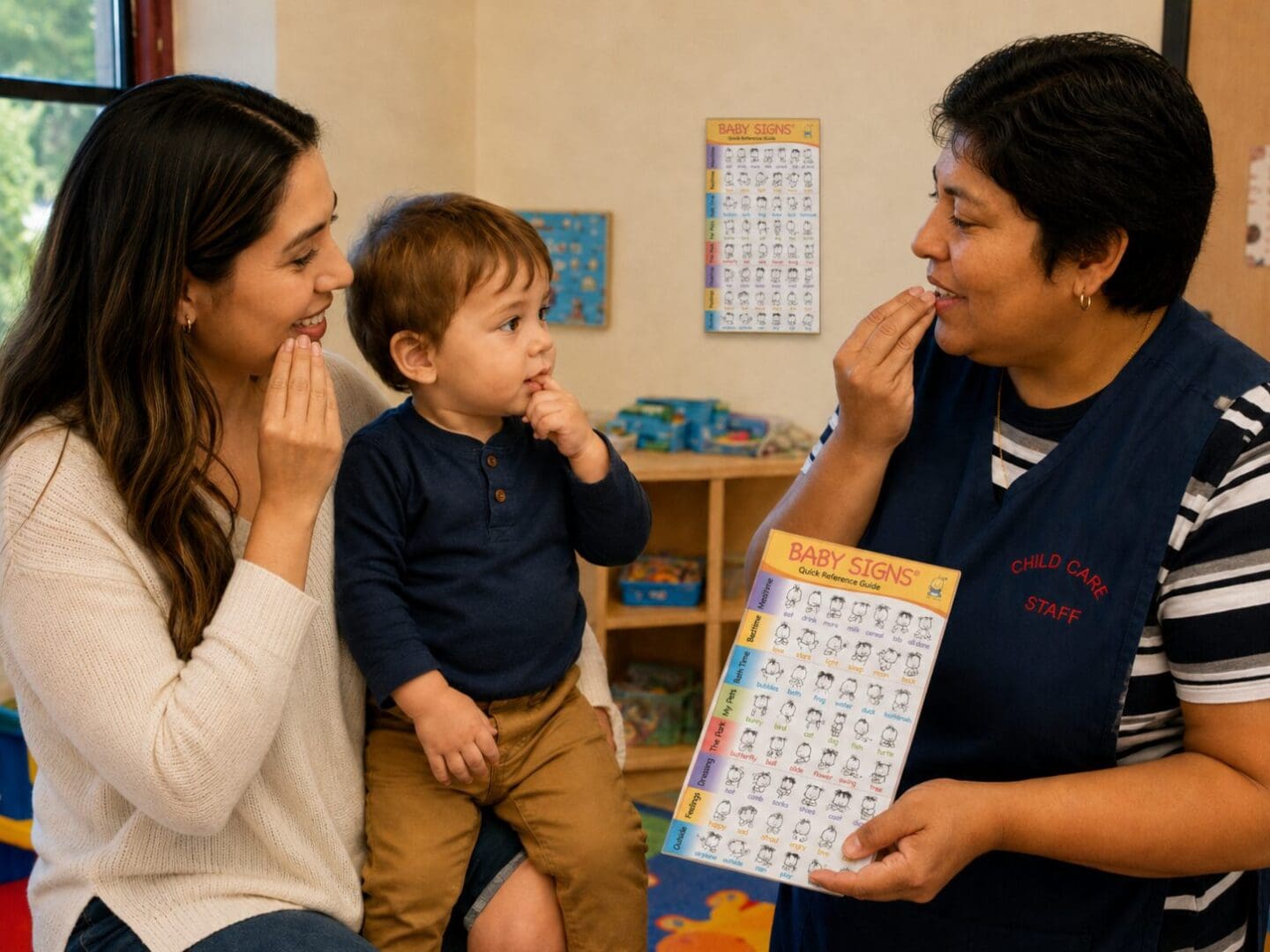
Parents can share five or six signs their baby sees or uses most often with child care providers. Caregivers can choose a small group of signs connected to the routines that happen repeatedly throughout the day.
For example, a baby's "starter set" for child care might include:
MORE • ALL DONE • EAT • DIAPER • HELP • SLEEP
As those signs become familiar, more can be added naturally.
Visual reminders can help, too. Keeping a Baby Signs® Quick Reference Guide(opens in new tab) or sign posters(opens in new tab) near the places where routines happen makes it easier for everyone to remember to use the same signs consistently.
For child care programs, consistency across teachers and classrooms can be especially helpful. When everyone uses the same signs for common routines, babies do not have to learn a different communication system every time there is a new caregiver or classroom.
A Common Language Before Words
Babies have a lot to say long before they have the words to say it.
They can tell us they want MORE.
They can tell us they are ALL DONE.
They can ask for HELP.
They can tell us something HURTS.
They can let us know they are thinking about MOMMY or DADDY.
And sometimes, they simply want to tell us what has caught their attention.
By incorporating signs into the routines that are already happening at home and in child care, adults can give babies an additional way to be heard, understood, and included in the conversations happening around them.
Babies do not only use signs to ask for things they want. They can also use signs to share what has caught their attention, start a conversation, or let us know what they are thinking about(opens in new tab).
Bring Baby Signs® Into Your Early Childhood Program
Would you like your entire staff to feel confident using signs throughout the child care day?
The Baby Signs® Early Childhood Educator Training and Center Certification Program helps early childhood professionals learn how to incorporate signs naturally into classroom routines, strengthen communication with preverbal children, and create greater consistency among staff and families.
Baby Signs® can become part of what your program already does every day, from meals and diapering to play, transitions, storytime, and family engagement.
Learn more about Baby Signs® Early Childhood Educator Training and Center Certification.(opens in new tab)
