More Than Signs: What Makes the Baby Signs® Program Unique
Long before babies can say their first words, they are already communicating.
They use eye contact, facial expressions, sounds, body movements, and gestures to let the people around them know what they need, want, notice, and feel. When parents, caregivers, and early childhood professionals recognize and respond to these early attempts, babies learn that communication works.
The Baby Signs® Program helps families and professionals build on this natural ability by giving babies simple signs they can use before they are able to speak clearly.
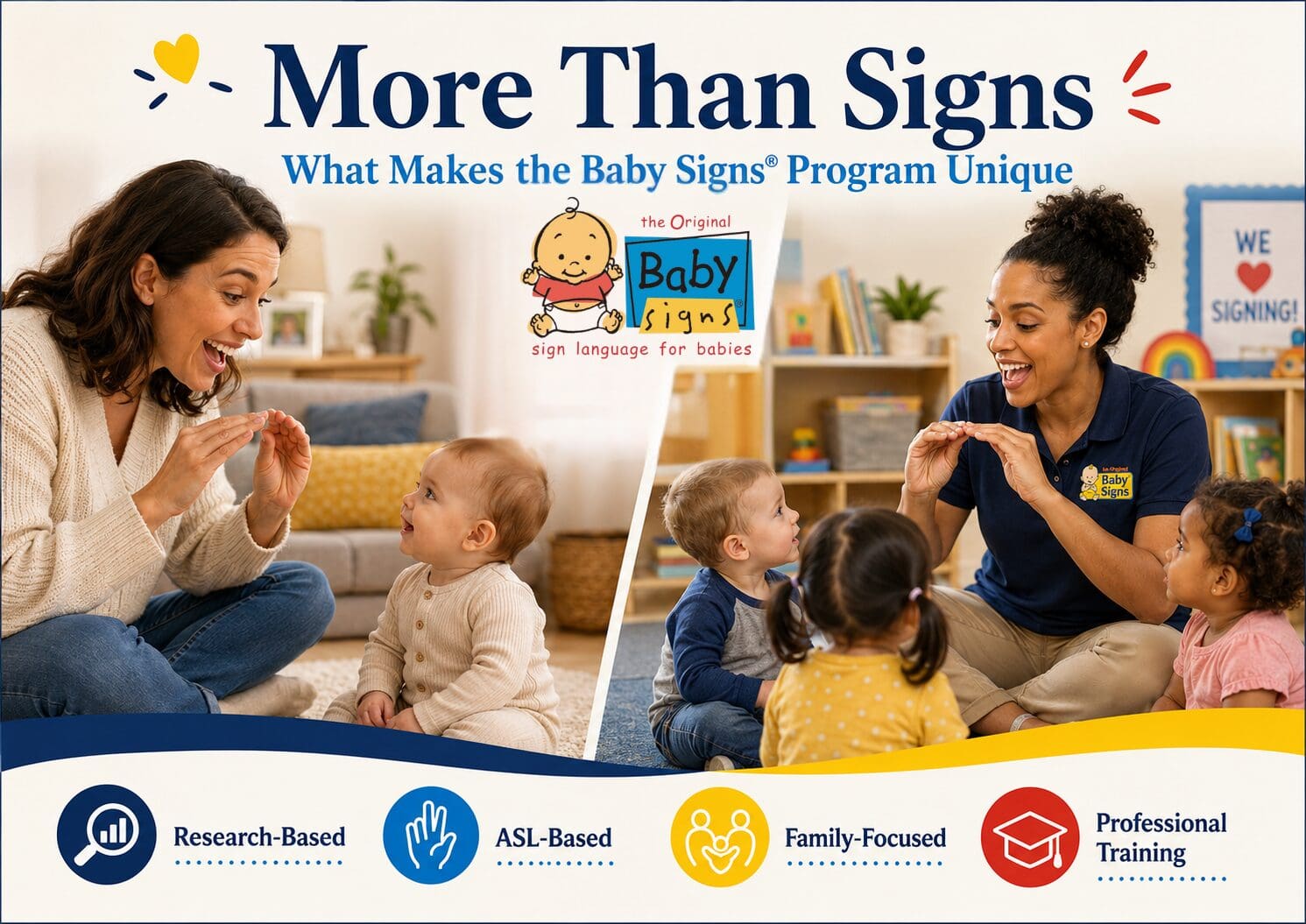
But the Baby Signs® Program is much more than a collection of signs. It is a research-based approach to early communication that supports babies, strengthens responsive relationships, and gives families and professionals practical tools they can use throughout the day.
Here are some of the qualities that make the Baby Signs® Program unique.
Created Specifically for Hearing Babies
The Baby Signs® Program was developed by child development experts Dr. Linda Acredolo and Dr. Susan Goodwyn after they observed babies creating gestures of their own.
They noticed that babies frequently used simple movements to represent objects and ideas before they could say the corresponding words. A baby might sniff to represent a flower, raise their arms to show something was big, or flap their hands to represent a bird.
These observations inspired years of research into how symbolic gestures could support early communication and development.
Unlike programs created to teach American Sign Language as a complete language, the Baby Signs® Program was designed specifically for hearing babies(opens in new tab) and their caregivers. Its purpose is to help babies communicate during the period when they understand more than they can say.
This developmental focus continues to guide the program today and helps families and professionals introduce signs in ways that are appropriate, meaningful, and responsive to each child.
Built on Research, Not Trends
The Baby Signs® Program grew out of academic research(opens in new tab), not a passing parenting trend.
Drs. Acredolo and Goodwyn studied how using symbolic gestures affected babies’ language development, communication, and interactions with caregivers. Their research helped address a common concern that signing might delay speech.
Instead, the findings showed that using signs alongside spoken words could support, rather than interfere with, verbal development.
When adults sign, they continue talking. Babies hear the word, see the sign, observe the adult’s facial expression, and experience the meaning within a familiar situation.
For example, a parent or educator might say and sign MORE while offering another bite of food, continuing a favorite song, or repeating a playful activity. The baby receives the same message through several connected channels.
This makes language visible while spoken-language skills are still developing.
For professionals, the research foundation provides more than reassurance. It offers a developmentally appropriate framework for using signs intentionally within early learning, home visiting, parent education, and caregiving settings.
Based on American Sign Language With a Flexible Approach
The Baby Signs® Program uses signs based on American Sign Language whenever possible.
However, babies are not miniature adults. Their hands, fingers, coordination, and motor skills are still developing. A baby’s first attempt at a sign may look very different from the adult version.
The Baby Signs® Program recognizes and celebrates these early approximations.
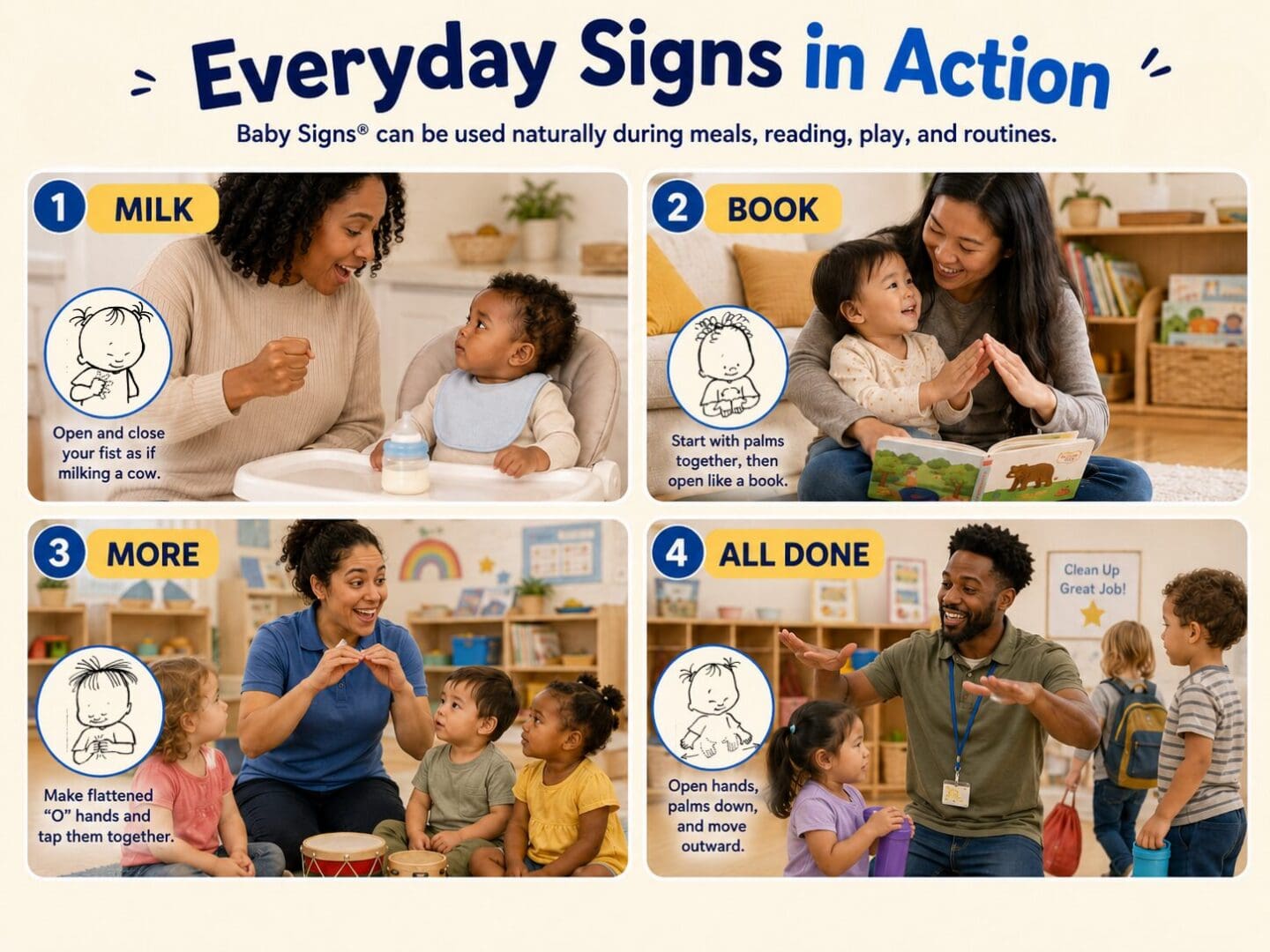
Just as adults respond to “ba” as an attempt to say “ball,” they can respond to a simplified hand movement as a baby’s attempt to sign MILK, MORE, or ALL DONE.
Families and professionals are encouraged to:
- Model signs correctly
- Accept the baby’s version
- Respond enthusiastically
- Continue saying the spoken word
- Keep communication relaxed and enjoyable
This flexible approach makes the program practical for real babies in real homes, classrooms, child care centers, and community programs.
The goal is not a perfect handshape. The goal is successful communication.
More Than Teaching Vocabulary
Teaching a baby the sign for MILK can be exciting, but the value of signing extends well beyond learning individual words.
Signing can support communication during many parts of a baby’s day, including:
- Mealtimes
- Diaper changes
- Bath time
- Bedtime
- Play
- Reading
- Outdoor activities
- Classroom routines
- Transitions
- Social interactions
Signs such as MORE, ALL DONE, HELP, HURT, SLEEP, EAT, DRINK, and PLAY can give babies practical ways to participate in familiar experiences.
A baby who can communicate HELP may have another option besides crying or becoming frustrated. A baby who signs ALL DONE can participate in ending a meal or activity. A baby who signs HURT may be able to draw an adult’s attention to discomfort.
In group settings, signs can also help educators make routines more visible and predictable. A teacher may use signs during songs, meals, diapering, circle time, cleanup, transitions, and story time.
These everyday moments teach babies that their communication has meaning and that the adults caring for them are listening.
Focused on the Whole Child
The Baby Signs® Program is grounded in child development.
Signing can support more than early vocabulary. It can also contribute to several important areas of development.
Social-emotional development
When babies communicate successfully, they experience the satisfaction of being understood. Responsive interactions can support confidence, trust, and connection.
In early learning settings, recognizing a baby’s signs can help educators respond more quickly and individually, even while caring for several children.
Cognitive development
Using a sign requires a baby to understand that a movement can represent an object, action, feeling, or idea. This is an early form of symbolic thinking.
Language development
Signs give babies a way to practice back-and-forth communication before spoken words are fully available. Adults naturally repeat important words while signing, helping connect the sign, spoken word, and experience.
Early literacy
Signs can make books more interactive. Babies can sign about familiar animals, objects, and actions while listening to a story, even before they are able to name them verbally.
Educators and caregivers can also use signs during songs, rhymes, and classroom activities to increase participation.
Self-regulation
Signs used during familiar routines can help make the day more predictable. An adult can use signs such as BATH, SLEEP, EAT, WAIT, and ALL DONE to help a baby understand what is happening and what comes next.
Although signs do not eliminate every difficult moment, they give babies another way to participate in routines and express themselves.
Parent and Caregiver Education Is Built Into the Program
The Baby Signs® Program does not simply tell adults which signs to teach.
Classes, workshops, professional training, and resources also help adults understand how babies communicate, learn, and develop.
Parents and caregivers learn how to:
- Recognize early communication attempts
- Choose signs that are meaningful to their family
- Introduce signs during everyday routines
- Follow the baby’s interests
- Pause and allow time for a response
- Respond to approximate signs
- Continue supporting spoken-language development
- Make communication playful rather than pressured
This education is one of the program’s most important features.
When adults better understand a baby’s development, they can create more responsive communication opportunities throughout the day.
Professional Training Goes Beyond Memorizing Signs
Professionals need more than a list of vocabulary words.
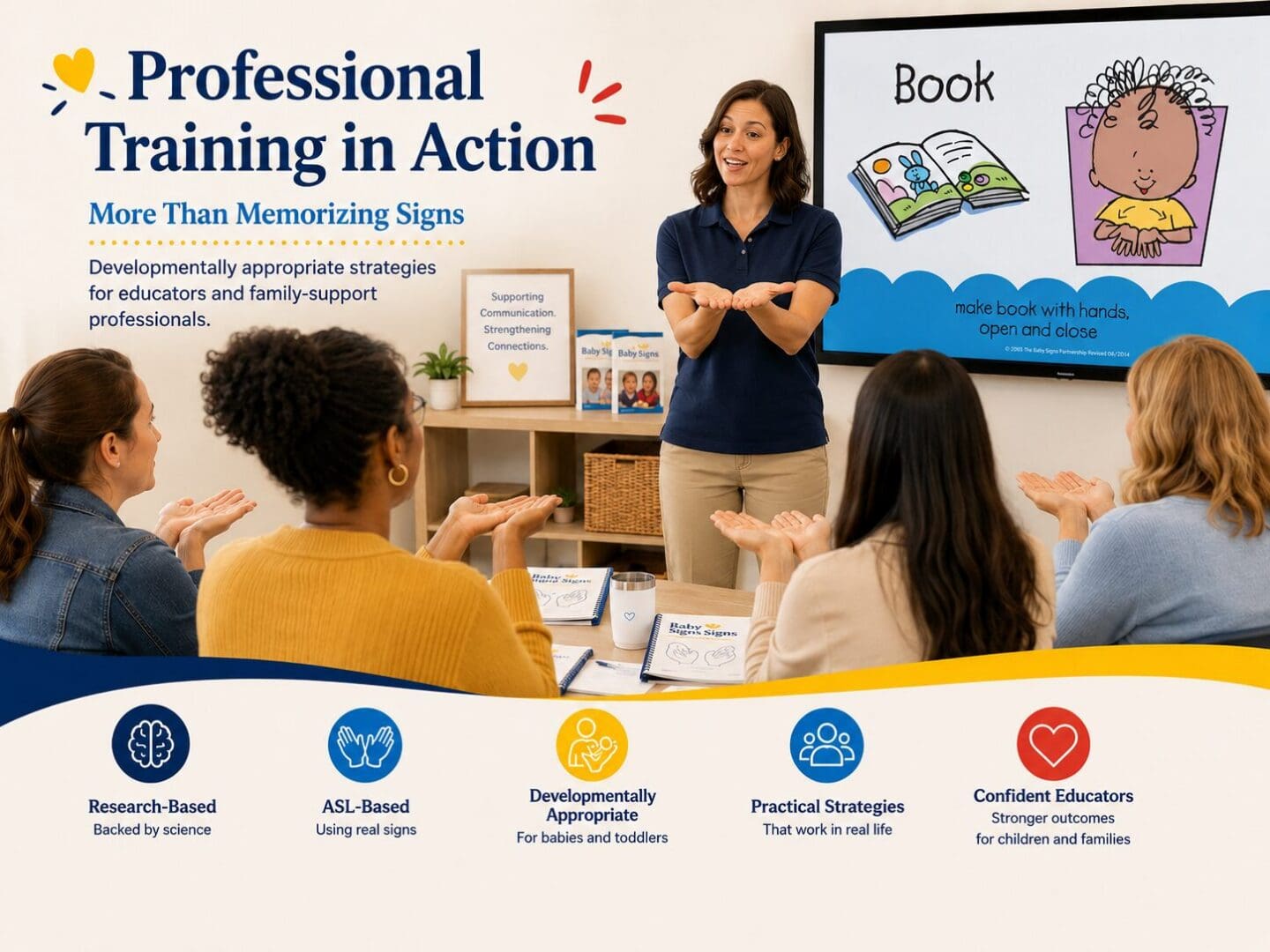
They need to understand how to introduce signs in developmentally appropriate ways, how to engage families, how to recognize babies’ approximations, and how to integrate signs into existing services and routines.
Baby Signs® professional training helps early childhood educators, home visitors, parent educators, nannies, family support professionals, and other caregivers understand both the signs and the developmental principles behind them.
Depending on the training, professionals may learn how to:
- Introduce signs naturally during daily routines
- Support communication without pressuring children to perform
- Recognize and respond to approximate signs
- Encourage consistency among caregivers
- Use signs during songs, books, play, and transitions
- Share practical signing strategies with families
- Support communication in multilingual environments
- Choose vocabulary that reflects children’s needs and interests
This helps professionals use signing purposefully rather than treating it as an isolated classroom activity.
Designed for Real Family and Classroom Life
Families do not need to set aside long practice sessions or turn signing into a formal lesson.
The Baby Signs® approach fits into routines that are already happening.
A parent might sign MILK before feeding, BATH while preparing the tub, BOOK before reading, and SLEEP as part of the bedtime routine.
An educator might use EAT before a meal, DIAPER during care routines, WAIT during a transition, BOOK at story time, and ALL DONE when an activity ends.
The most effective signs are usually connected to experiences that happen often and matter to the baby.
Families and professionals can begin with only a few signs and add more as the baby’s interests and needs change. Some babies may be especially motivated by food signs. Others may first sign about animals, toys, music, movement, or favorite people.
There is no single list that every baby, family, or classroom must follow.
Supports Consistency Across Caregivers and Settings
Signing can be especially helpful when babies are cared for by several different adults.
Parents, grandparents, nannies, child care providers, home visitors, and early childhood educators can use the same signs during familiar routines. This creates a shared communication system around the baby.
Consistency can be particularly valuable when a baby is:
- Beginning child care
- Moving into a new classroom
- Adjusting to a new caregiver
- Participating in a home visiting program
- Living in a multilingual household
- Learning routines in more than one setting
When adults recognize a baby’s signs and respond in similar ways, the baby receives a clear message:
Communication works wherever I am.
For child care centers and early childhood programs, staff training can help create this consistency across classrooms rather than relying on one educator who happens to know a few signs.
Welcoming to Multilingual Families and Classrooms
The Baby Signs® Program can also provide a helpful visual bridge in multilingual homes and early learning environments.
A sign can be used alongside the spoken word in more than one language. For example, family members and educators may use the same sign while saying the word in English, Spanish, French, or another home language.
The sign does not replace either language. It gives the baby a consistent visual symbol that can connect words, people, and settings.
This can help families preserve and celebrate their home languages while building shared communication with other caregivers and professionals.
Training and Resources for Families and Professionals
The Baby Signs® Program provides learning opportunities and resources for a wide range of audiences.
Families can learn through parent workshops, play classes, books, videos, and other signing resources.
Professionals and organizations can choose from training options designed for their work with babies, toddlers, caregivers, and early childhood programs. These may include:
- Workshops for professionals(opens in new tab)
- Early Childhood Educator Training and Center Certification(opens in new tab)
- Nanny Certification
- Baby Signs® Instructor Certification(opens in new tab)
- Agency and organizational training
Certified Baby Signs® instructors can offer developmentally appropriate classes, workshops, and programs for families and professionals in their communities.
This range of options allows the program to support communication at home, in child care, during home visits, in parent education programs, and throughout early childhood systems.
Communication That Grows With the Baby
Signing is designed to support babies during the communication gap between understanding language and speaking clearly.
As speech develops, babies typically begin using spoken words instead of signs when the words become easier and more efficient. Some may continue to use signs while saying the word, and others may gradually stop signing altogether.
There is no need to formally “wean” a child from signs.
The transition usually happens naturally.
The goal of the Baby Signs® Program is not to replace spoken language. It is to give babies a helpful communication tool while speech is still developing.
The Original Baby Signing Program
For more than three decades, the Baby Signs® Program has helped families and professionals recognize that babies have much more to say than their developing speech allows them to express.
Its combination of child development research, an ASL-based flexible approach, parent and caregiver education, practical routines, professional training, and classroom support makes it more than a sign vocabulary program.
It is a complete approach to responsive early communication.
Every time an adult notices a baby’s attempt, responds to a gesture, acknowledges a sign, or pauses to give the baby time to participate, the baby learns something powerful:
My ideas matter. My communication has meaning. I can make myself understood.
That is what makes the Baby Signs® Program unique.
Ready to Experience the Baby Signs® Difference?
Families can explore Baby Signs® classes(opens in new tab) and resources that make signing easy to use during everyday routines.
Early childhood professionals, agencies, and organizations can learn more about professional workshops, Early Childhood Educator Training(opens in new tab), Center Certification, Nanny Certification, and Baby Signs® Instructor Certification.
Whether signing is introduced at home, in a classroom, during a home visit, or through a community program, the goal remains the same: helping babies communicate before they can talk.
