More Than MILK: How Signs Support Communication During Feeding
Feeding a baby is about much more than providing nourishment. It is also a time for closeness, eye contact, observation, and back-and-forth communication.
Long before babies can say words such as “milk,” “more,” or “all done,” they communicate through sounds, facial expressions, body movements, and gestures. When parents and caregivers respond to these early cues, feeding becomes a conversation.
During World Breastfeeding Week, observed August 1–7, we celebrate the many ways families, professionals, workplaces, and communities can support breastfeeding. The 2026 campaign focuses on breastfeeding as a sustainable start in any circumstance and on strengthening actions that work.
One simple way to strengthen communication during feeding is to add signs to the words, routines, and cues already shared between a baby and caregiver. Using Baby Signs® during feeding gives babies another way to participate in these familiar daily routines.
The research-backed Baby Signs® Program helps babies communicate their needs, feelings, and discoveries before they can talk.
Feeding Is Already a Conversation
Babies communicate hunger and fullness in many ways. A hungry baby may become more alert, bring their hands toward their mouth, reach toward a caregiver, or show interest in feeding. A baby who has had enough may slow down, turn away, close their mouth, or lose interest.
Responsive feeding means noticing these signals and responding to them. The American Academy of Pediatrics explains that responsive feeding can be practiced during breastfeeding, bottle-feeding, and the introduction of solid foods.
Signing does not replace these important cues. Instead, it gives babies and caregivers another way to participate in the conversation.
Start With the Sign for MILK
MILK is often one of the first signs families introduce because feeding is such a familiar and frequently repeated part of a baby’s day.
Before nursing or offering a bottle, get your baby’s attention and say:
“Do you want MILK?”
Say the word naturally while demonstrating the sign. You can repeat it again as feeding begins:
“Here is your MILK.”
There is no need to turn the moment into a lesson or ask your baby to copy you. Simply use the sign consistently as part of the routine.
Over time, your baby may begin to associate the sign with the experience of being fed. When babies eventually attempt the sign themselves, their movements may not look exactly like the adult version. That is perfectly normal. Just as early spoken words are not always pronounced clearly, early signs are often simplified to match a baby’s developing motor skills.
Respond enthusiastically to your baby’s attempt, then continue demonstrating the sign correctly.
Watch how to demonstrate the ASL sign for MILK.
For Breastfeeding Families: Consider the Sign for NURSE
For families who are breastfeeding, the sign for NURSE can be another meaningful addition to feeding routines. While MILK works well as a broad sign for feeding, some parents may also choose to use NURSE to refer specifically to breastfeeding.
You might say:
“Do you want to NURSE?”
or
“It’s time to NURSE.”
As with any sign, there is no need to test your baby or expect an exact imitation right away. Simply model the sign consistently during meaningful moments. Over time, your baby may begin to connect the sign with the comfort, closeness, and routine of breastfeeding.
Some families choose to use both MILK and NURSE, while others use just one. Either approach is perfectly fine. What matters most is using signs consistently and responding to your baby’s communication attempts with warmth and attention.
Go Beyond MILK
As your baby becomes familiar with MILK, consider introducing a few additional signs that can make feeding routines more interactive.
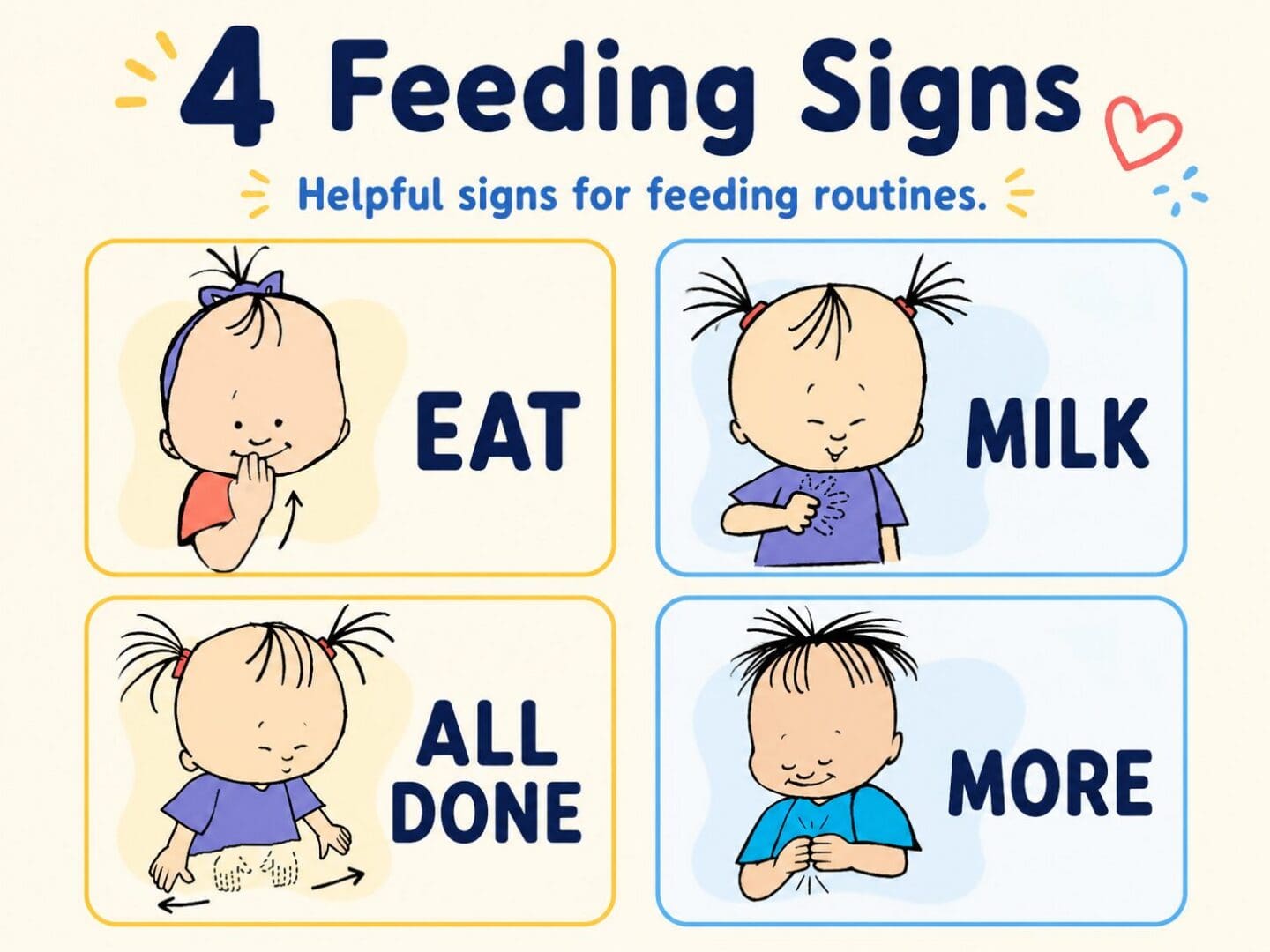
EAT
Use EAT when preparing for meals or introducing solid foods:
“It’s time to EAT.”
Using the sign before placing your baby in the highchair can also help make the daily routine more predictable.
MORE
MORE can help babies request that an enjoyable activity continue. During feeding, pause and ask:
“Would you like MORE?”
Remember to consider all of your baby’s cues. A baby may sign MORE because they enjoy the interaction, not necessarily because they are still hungry. Respond to the sign while also observing your baby’s facial expressions, body language, and interest in the food.
ALL DONE
ALL DONE is just as important as MORE.
Use it when the feeding ends:
“You’re ALL DONE.”
As babies begin using the sign themselves, it can give them a clear, positive way to participate in ending the meal. Consistently acknowledging ALL DONE also shows babies that their communication matters.
Keeping a visual reminder nearby can make it easier to use signs consistently. The Baby Signs® Quick Reference Guide includes 67 illustrated signs for common needs, routines, feelings, and everyday experiences.
These four simple signs can give babies more ways to participate in everyday feeding routines.
Use Signs Naturally, Not as a Test
The easiest way to introduce signs is to make them part of what you already do.
You do not need a separate signing practice session. Use the sign as you say the word during real experiences:
- Sign MILK before nursing or offering a bottle.
- Sign EAT as you prepare a meal.
- Sign MORE before offering another bite.
- Sign ALL DONE when the meal ends.
Try to pause briefly after asking a question. This gives your baby time to respond with a sound, movement, facial expression, gesture, or sign.
All of those responses are communication.
Follow Your Baby’s Lead
A feeding routine should not become a performance or a test of whether your baby remembers a sign.
Your baby may watch the sign without attempting it for weeks or months. That does not mean they are not learning. Babies often understand familiar words and signs before they are physically able or ready to use them.
Continue to:
- Say the word while making the sign.
- Use the sign in a meaningful situation.
- Watch for your baby’s version of the sign.
- Respond to all communication attempts.
- Keep the experience relaxed and positive.
The goal is not to teach a perfect sign. The goal is to help your baby experience the power of being understood.
Create Consistency Among Caregivers
Signing becomes even more helpful when the important adults in a baby’s life use the same signs.
Share the signs for MILK, EAT, MORE, and ALL DONE with grandparents, child care providers, nannies, and other caregivers. These tips for getting caregivers involved can help everyone use and recognize the same signs.
For example, your baby’s attempt at MILK may be a small opening and closing movement of one hand. When every caregiver recognizes and responds to that movement, your baby learns an important lesson:
My communication has meaning, and the people who care for me are listening.
Every Family’s Feeding Journey Is Different
World Breastfeeding Week is an opportunity to recognize the importance of breastfeeding support while also treating families’ individual circumstances with care and compassion.
Some babies are fed directly at the breast. Others receive expressed breast milk, formula, or a combination. Families may experience medical challenges, feeding difficulties, changes in milk supply, returning to work, adoption, surrogacy, or other circumstances that shape their feeding journey.
Signs can support communication during all of these experiences. The sign for MILK can represent the feeding routine that is meaningful within your family.
What matters most is the responsive interaction between baby and caregiver: watching, listening, responding, and helping a baby feel safe and understood.
More Than a Feeding Sign
MILK may be one of the first signs a baby learns, but its impact can extend far beyond feeding.
Each time you pause, observe, and respond, you show your baby that communication is a two-way experience. Each time you acknowledge a sound, gesture, or sign, you strengthen your baby’s confidence as a communicator.
That is why the sign for MILK can represent so much more than a feeding method or source of nourishment.
It represents connection.
It represents responsiveness.
Most importantly, it gives your baby another way to be heard.
Ready to Start Signing With Your Baby?
You do not need to wait until your baby can talk to begin meaningful conversations. The Baby Signs® Parent Guide includes step-by-step instructions, a roadmap from first signs to first words, and an illustrated glossary of 100 useful signs for feeding, play, bedtime, and everyday routines.
Prefer to learn with an instructor? Find a Baby Signs® class near you.
Families with concerns about breastfeeding, bottle-feeding, swallowing, growth, pain, or other feeding difficulties should consult their pediatrician, lactation professional, or another qualified health care provider.
